


Services
A bare-metal DVB headend in our Tier III data center. You run the streaming, monitoring, or recording stack you already know
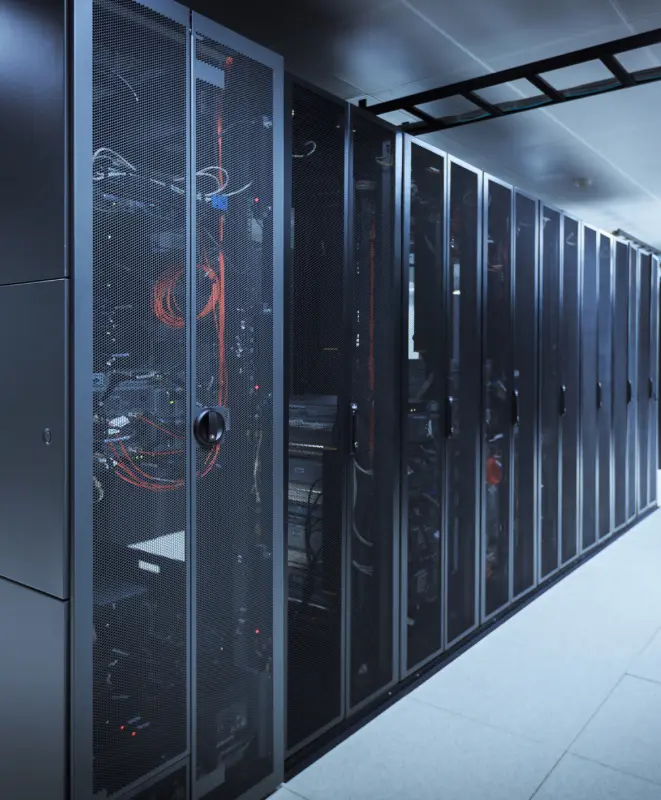
Dedicated servers with real PCIe DVB-S2X tuners, a satellite LNB downlink, and optional dedicated GPUs for transcoding. Hosted in our Tier III data center in Vilnius. Configured to your specification and ready to use within 24 hours.
Three reasons mid-size broadcast and streaming operations move their headend to Satline
1
The all-in-one capex is the wrong shape for a mid-size headend operation
Building a satellite headend from scratch is a serious undertaking.
A setup like this generally calls for a large dish (somewhere in the
1.2m–3.7m range depending on band and footprint), a multi-LNB
assembly and multiswitch, several professional PCIe DVB-S2X
tuner cards at a few hundred euros each, an enterprise-grade
server built for 24/7 operation, out-of-band management,
colocation rack space, an IP transit contract, and an engineer to
commission the lot.
There’s no single ‘right’ build — plenty of different hardware
combinations land the same result — but whichever route you
take, the bill of materials runs into five figures before the first
stream goes out, and the work takes weeks rather than days.
Satline removes the entire chain. You order a configured
server with the tuner cards already installed, the satellite
already wired to the LNB downlink, and the OS template ready
to provision. The server is ready to use within 24 hours.
The €50 setup fee is the only one-time cost.

2
Your stack on your hardware.
Not a hyperscaler’s product catalog
Hyperscaler video pipelines (AWS Elemental MediaLive, Google Cloud
Live Stream API) work if your workflow matches the product they sell.
They get expensive and rigid when it does not. Generic dedicated server providers give you the server but cannot help with the satellite feed.
Satline’s Dedicated DVB sits between the two: a fully dedicated server
with all CPU, RAM, RAID, and GPU resources allocated exclusively to you,
plus an actual satellite LNB downlink wired into a PCIe tuner card on the
same chassis.
Root SSH access, iLO or iDRAC remote console, and your existing software stack installed on top, whether that means live restreaming (Flussonic, Wowza, Cesbo Astra), recording and EPG capture (TVHeadend, WebGrab+Plus, custom FFmpeg pipelines), or transport-stream monitoring and signal analysis.

3
Satellite reception requires geographic line of sight.
Our data centers already have it
A satellite headend only works if the dish can see the satellite. Our Vilnius
dish farm covers 15 orbital positions from 80°E to 34.5°W, including eastern positions (Express-80 at 80°E, ABS-2 at 75°E, Express-AMU1 at 36°E) that western European teleports cannot easily reach.
The reception engineering, the heated antennas (the ST-2700H, ST-1800H, and ST-1500H dishes all have integrated heating for winter reception), the
24/7 monitoring, and the rack space are already there. When you configure
a Dedicated DVB server with us, the LNB downlinks are connected to the
satellites you need on day one.

Features
We’re changing the way people connect
Enterprise hardware, real control, and redundancy at every layer – infrastructure you can depend on.
High-performance hardware
Modern and reliable Hewlett Packard Enterprise equipment ensures flawless performance. Each server features RAID controllers supporting redundancy levels.
User-friendly management
Manage your virtual server through an intuitive control panel and API, or your dedicated server via integrated remote management platforms like iLO (Integrated Lights-Out) or iDRAC (Integrated Dell Remote Access Controller), offering powerful system management tools for seamless configuration and monitoring.
DDoS protection
Up to 5 Gbps protection against DDoS attacks and malicious traffic, ensuring system availability and uninterrupted operation by allowing only clean user traffic.
Redundant cloud platform
Virtual servers are hosted on a redundant cloud platform, duplicating internet connectivity, power supply, and physical servers, enabling automatic failover to ensure continuity.
Pre-configured OS templates
Cloud servers support the most popular Windows and Linux operating systems, available as ready-to-use templates, saving time and effort in configuration.
Offers
Pick your ideal server configuration
Choose a server tailored to your needs at a special price, ready to use within 24 hours.
A real headend on real hardware. No shared resources, no virtualization tax
Every Dedicated DVB tier ships with the same core hardware specifications and the same network and data center guarantees. The difference between tiers is tuner count, CPU class, RAM size, and GPU availability. Below is the technical baseline that applies to every server.
Digital Devices Max SX8 Pro PCIe tuners
Intel Xeon processors with ECC RAM
Optional NVIDIA GPU transcoding
Tier III data center, hardware RAID, redundant network
Out-of-band remote management on every server
Any application that speaks the Linux DVB API or SAT>IP
Order, configure, deploy
Choose your configuration
We provision the server
Install your software stack
Three setups Satline’s Dedicated DVB tier was built for
The customers who land on this tier rather than Virtual SAT>IP share three traits: they need more than a single tuner endpoint, they have their own software stack — streaming, monitoring, recording, or EPG - that they want to keep running, and they need the security and control of a fully dedicated server. Below are the three scenarios we see most often
1
Mid-size IPTV operators outgrowing virtual hosting or DIY setups
An IPTV operator running 30 to 300 channels needs more than a virtual
SAT>IP endpoint can provide. They need their own server with their own
IPTV stack, multiple tuner cards for multiple satellite positions, and
headroom to add transcoding when traffic grows. They have typically
tried two paths first.
Running everything off virtual hosting hits a ceiling on tuner count and concurrent throughput. DIY at a generic hosting provider works until
the satellite reception layer becomes the problem they cannot solve from
a standard server rack. Dedicated DVB is the natural next step: a real
server with real PCIe tuners and a real LNB downlink, sitting in a Tier III
data center with the satellites already in line of sight.

2
Hospitality and integration partners building white-label IPTV solutions
System integrators delivering IPTV to hotel groups, hospital
networks, or campus customers often need a dedicated
headend per project or per region. Buying hardware and
paying for colocation per project is slow and capex-heavy,
and every new contract means another site visit.
With Satline's Dedicated DVB, each project gets its own server
with its own tuner card count, configured for the specific channel
lineup the customer needs, hosted in our Vilnius data center.
The integrator controls the middleware, the channel encoding,
and the customer-facing UI. We deliver the satellite signal and the
hardware underneath it. The same setup replicates cleanly across
multiple customer contracts without managing physical hardware
in each location.

3
Broadcasters, monitoring agencies, and FAST channel operators needing dedicated capacity
Tier-2 broadcasters, media monitoring firms, EPG and metadata
aggregators, and FAST (free ad-supported streaming TV) channel
operators run continuous 24/7 ingest workloads that need
predictable, dedicated capacity.
A media monitoring firm watching 24 channels across 5 satellites
needs every tuner accessible at all times for compliance recording
and logging. An EPG aggregator pulling EIT schedule data from dozens
of transponders needs every position in line of sight at once. An
engineering team running 24/7 signal monitoring needs continuous
access to carrier, MER, and BER statistics straight off the demodulators.
A FAST channel operator sourcing long-tail content from FTA satellite
feeds needs reliable reception and the headroom to transcode multiple
outputs in parallel. The DVB #3 configuration (12 LNB downlinks across
3 satellites, dual Xeon Gold, 128 GB RAM, up to 3 GPUs) matches these workload profiles while keeping the operational simplicity of renting
versus owning the hardware.

Have questions?
Talk to one of our engineers to learn more about what we offer and how it fits your needs.
Testimonials
What our clients say
Recommend providers
“Good support, stable satellite server. You should buy a server from this provider!”
Satline offers a lot of highly…
“Satline offers a lot of highly configurable and customizable services. They were able to build me a dedicated DVB server that had exactly what I needed, and had the performance required. I am also satisfied with the tech support. They are fast to answer my questions. No issues!”
I found the team to be very smart and…
“I found the team to be very smart and resourceful. They helped me configure my servers and tuners, much faster than if I did everything myself. They also gave me some ideas to save money on my equipment.”
FAQ
Nine questions buyers ask before they order a Dedicated DVB server
What are the key features of Satline's dedicated servers?
Key features include high-performance Xeon processors, up to 128GB RAM, multiple DVB devices, LNB connectivity, and optional GPU integration for enhanced processing.
What types of GPUs are available for these servers?
What satellite positions do you have?
- 0.8°W - Thor 5/6/7 & Intelsat 10-02
- 4.0°W - Amos 3/7
- 4.9°E - Astra 4A & SES 5
- 9.0°E - Eutelsat 9B & Ka-Sat 9A
- 13.0°E - Hotbird 13F/13G
- 16.0°E - Eutelsat 16A
- 19.2°E - Astra 1KR/1L/1M/1N
- 21.5°E - Eutelsat 21B
- 23.5°E - Astra 3B/3C
- 28.3°E - Astra 2E/2F/2G
- 30.0°W - Hispasat 30W-5/30W-6
- 36.0°E - Eutelsat 36B & Express AMU1
- 75.0°E - ABS 2/2A
- 80.0°E - Express 80.
What’s the difference between a Dedicated DVB server and a Virtual SAT>IP server?
Virtual SAT>IP is a hosted tuner endpoint: you connect to our infrastructure through the standard SAT>IP protocol and we deliver satellite channels over IP. The server, the tuner, and the operating system are all ours; you only get the SAT>IP feed. Dedicated DVB is a fully dedicated bare-metal server where you get root access, your own choice of software, and exclusive use of all hardware resources including the PCIe DVB tuner cards. Choose Virtual SAT>IP for single endpoints, small operations, or testing. Choose Dedicated DVB when you need 30 or more channels, your own software stack (streaming, monitoring, recording, or EPG), multiple satellite positions on a single server, or GPU transcoding capacity.
Can I install Flussonic, Wowza, or Cesbo Astra on the server?
Yes. The server is fully dedicated and you have root SSH access, so you install whatever software your operation runs. The DVB tuner cards are exposed to the OS as standard Linux DVB devices, which means any application that supports the Linux DVB API will detect and use them directly. Streaming servers (Flussonic, Wowza, Cesbo Astra), recording and EPG tools (TVHeadend, WebGrab+Plus), transport-stream monitoring and analysis software, and custom FFmpeg pipelines all work out of the box, alongside whatever middleware your operation runs on top. We do not lock you into a Satline-specific software stack.
What is GPU for, and why would I need it in my server?
GPU is for transcoding. If your headend needs to transcode satellite-received MPEG-2 or H.264 channels into multi-bitrate H.264 or H.265 ABR ladders for OTT distribution, the GPU’s hardware NVENC encoder handles that workload at much higher density than CPU transcoding. A single GPU has 16 GB ECC GDDR6 memory and the professional-card NVENC/NVDEC pipeline. GPU is optional on DVB #2 (up to 1 GPU) and DVB #3 (up to 3 GPUs). DVB #1 does not support GPU. If your operation is ingest-and-distribute only (no transcoding), you do not need GPU; the CPU handles ingest and packaging on its own.
What about the €50 setup fee?
Can I receive encrypted satellite channels?
Conditional-access support depends on the broadcaster, the encryption system, and the licensing situation. For free-to-air content, no encryption hardware is needed. For BISS-encrypted contribution feeds where you hold the keys, the server can handle decryption in software. For commercial CI/CAM-based conditional access (CI+ slots, smartcards), talk to our engineering team about your specific setup; some configurations are possible on dedicated hardware that are not on virtual hosting. Decryption is always the customer’s legal responsibility and should only be used where lawful access exists.
How long does provisioning take?
Ready to use within 24 hours from the moment we have your configuration details (data center, satellite positions, OS template, any custom requirements). For custom builds with specific hardware not in our standard inventory, lead time may be longer; our engineering team will quote a specific timeline at order.